2011 GENERAL MUNICIPAL ELECTION
for BOONE, NC
NOVEMBER 8TH


IMPORTANT

NOTE to New River 1 Precinct Voters:   Your polling location has permanently changed.  On election day, you no longer vote at Watauga County High School.  You now vote at the Boone Town Council Chambers on Blowing Rock Road.
NOTE to Brushy Fork Precinct Voters:   Your polling location has changed for this election only.  On election day, you will  vote at the County Administration Building beside the County Courthouse on King Street.
NOTE to Blue Ridge Precinct Voters:   Your polling location has changed for this election only.  On election day, you will  vote at the National Guard Armory on State Farm Road,

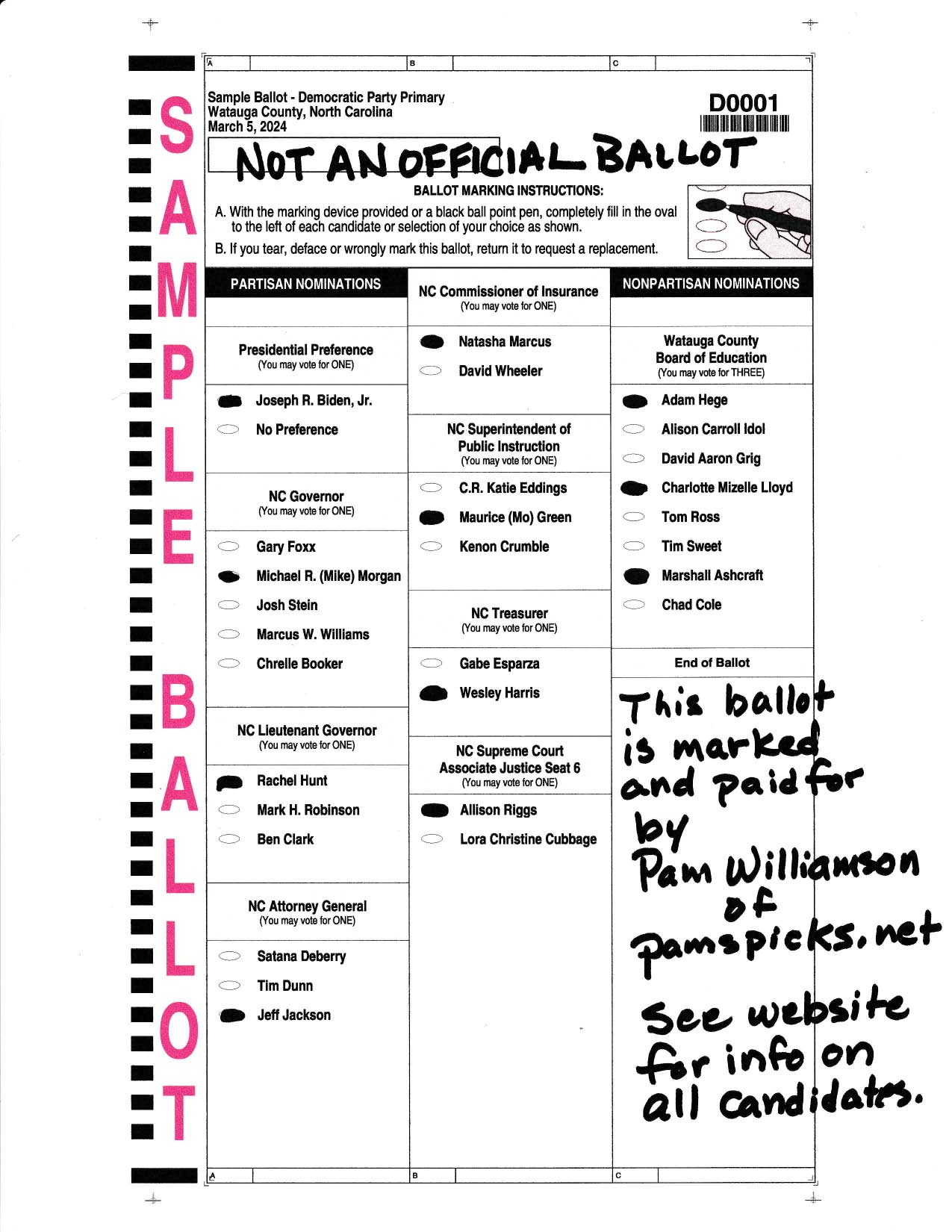
HOW I WILL CAST MY BALLOT: (in the order the names appear on your ballot)
ANDY BALL
LYNNE MASON
ALLAN SCHERLEN

Click HERE for shortcuts to all other information on this site

BOONE TOWN COUNCIL (you may pick up to THREE):

DISCUSSION: Three seats are open on the Boone Town Council. While four candidate names appear on your ballot, one candidate (Anne Rasheed) has withdrawn from the race, saying she does not have the time to serve the office.

The two top vote getters in the race will achieve four-year terms on the Town Council; the third top vote getter receives a two-year term. Since Rasheed has officially withdrawn, this leaves the three remaining candidates competing for the two four-year terms.

The Disclaimer: What is Pam's Picks?
“Pam’s Picks” is simply one person’s opinion about the upcoming election races.  I am a Town of Boone resident and have long held interest in local politics. I have researched candidate campaign platforms and records where available. I have also supplied candidate web site references below where available. For additional information, you can follow the provided links or contact candidates directly with your questions.

What's in Pam's Picks?
Below you will find:  general voting information (when and where) and information on candidates whose names will appear on the November 8th ballot (the candidates are presented in the order they will appear on your ballot). 

SHORTCUTS to The Information On This Site:
Click here for "DISCUSSION" (personal message about this year's elections and choices).
Click here for the Pam's Picks disclaimer.
Click here for voting information (where and when you vote and who can vote this ballot).
Click here to read my endorsements for BOONE TOWN COUNCIL.
Click here to read individual candidate responses to my questionnaire for BOONE TOWN COUNCIL.

VOTING INFORMATION
Who Can Vote this ballot?: All registered voters who reside within the Boone Town limits. This includes ASU students who live in dormitories on campus as well as those who live in the town limits in off-campus housing.

When and Where to Vote: Election Day proper is Tuesday, November 8th, BUT YOU DON’T HAVE TO WAIT UNTIL THEN TO VOTE!   Early “one-stop voting” is available in 2 locations this year at varying hours and dates:

The Watauga County Board of Elections (inside the Courthouse)
Thursday, October 20 (weekdays from 8AM-5PM) - Saturday, November 5 (8AM-1PM)

The Multi-Cultural Center in ASU's Student Union (Across from CrossRoads coffee shop)
Monday, October 31- Friday, November 4 (10AM-5PM)


Not Registered to Vote?: You can “Same Day Register and Vote.” During early one-stop voting ONLY, you can both register and vote at the same time.  YOU CANNOT SAME-DAY REGISTER ON ELECTION DAY PROPER.  To register and same-day vote, you will need to present identification that shows proof of Watauga County residency (i.e., one or more of the following:  a driver’s license with a local address, a document from ASU showing current name and address --pink piece of paper that lists your dorm, a lease agreement, a paycheck stub, a bank statement, or a utility bill in your name that includes a local address).  If you are a student, it’s a good idea to take your ASU Student ID as well.

If you vote on November 2nd (Election Day), where do you vote?”:
Blue Ridge: National Guard Armory on State Farm Road
Boone 1: 
Watauga County Administration Building, beside the Courthouse
Boone 2: 
ASU Student Union, Blue Ridge Ballroom
Boone 3: 
Farthing Auditorium
Brushy Fork: County Admiinstration Building beside the Courthouse
New River 1:  Boone Town Council Chambers on Blowing Rock Road
New River 2: 
Three Forks Baptist Association
New River 3: 
National Guard Armory

Polls are open on Election Day, November 8th, from 6:30AM-7:30PM.

Need More Information?: Call the Watauga County Board of Elections at 265-8061.

CANDIDATE INFORMATION SOURCES:
Information for my candidate discussions below comes from individual candidate information online as well as candidate responses to a questionnaire I sent to all candidates on September 21st.


BOONE TOWN COUNCIL CANDIDATES:

Andy Ball:  http://www.andyballforboone.com/ and Andy Ball for Boone Town Council on Facebook

Brief Candidate Statement Excerpt:

Ball, 28, will seek a second term on the Council after being elected the youngest elected official in Watauga County history. Councilman Ball is a senior at ASU studying Government and Public Policy, and works in the local hospitality industry and as an independent consultant. He is involved with Appalachian Voices, MountainKeepers, and PHARMN, a non-profit collaborative supporting the Watauga Farmer’s Market. Ball serves as Council liaison on the Historic Preservation Commission, the Economic Development Commission and the Sustainable Development Task Force. He also served on the Boone Board of Adjustment before being elected to Town Council in 2009.

(1) The Town of Boone adopted its “Boone 2030 Land Use Plan” in 2009. Do you support this plan? What do you consider to be the strongest part of the plan? What do you consider to be the weakest part of the plan?


I strongly support the goals of the 2030 Land Use Plan, and believe it is crucial that we work constantly to codify these development and transportation-related goals so they can have some teeth and be enforced.  The plan was developed over the course of several months, after a rigorous public hearing process, and stakeholder input from a variety of community groups. 

The strongest portion of the plan is the integration of ecologically-friendly and sustainable development tenets throughout the document.  The community came to a handful of public hearings and told us they wanted us to preserve water quality and the overall health of our environment.  This is my core issue, and one I plan to continue work on in my next term.

The weakest part of the plan is that it doesn’t go into enough detail regarding the options available to the Town using form-based code.  Throughout the document, it alludes to “focus areas” and “developing a plan for” different areas.  The Lawrence Group are professional planning consultants, and the Town can benefit from seeing what ideas have worked and which ones have not in other communities.

The other weakness of the plan is that it is just a plan.  It’s not law.  We have integrated the document into our project approval process quite well, but the visionary and ecologically friendly ideas such as the Kraut Creek Restoration Project located along the 321 corridor at Red Roof Inn and the Scottish Inn are already losing out to a large hotel and stand-alone restaurant concept.  This plan needs to remain at the forefront when we hear new development requests, or we’ll never get there.

I don’t believe we will see Boone in 2030 looking anything like this plan if the majority of Council doesn’t act NOW to prioritize these various aspects.  I am committed to following through on implementation of the 2030 plan throughout my time on the Council.
 
(2) Once the Town’s new water intake facility is completed, the Town will have the resources to provide water to county properties, but there is no comprehensive zoning in the county. Do you support or oppose a requirement that county properties applying for water follow Town of Boone zoning regulations in exchange for water resources? Please explain.
 
IF the Town gets the DENR permit in hand by next summer, we can go to bid immediately and begin allocating funds by the September 2012 deadline.  The intake facility as designed is state-of-the-art, and one Boone residents will be proud of.  We have committed to advanced filtration systems for potable water at this facility, and I am continuing to look at the availability and cost of cutting edge treatment systems that would rid wastewater of chemical byproducts of pharmaceuticals.  We will explore such a treatment system when it becomes commercially available. 

It will be a welcome reversal to begin granting water requests outside town, but it will require that we make those decisions taking many factors into account.  I believe in zoning and smart land use planning.  Our development policies should allow developers to build to their bottom line as long as they take extra steps, and incur a few extra costs, to make their projects fit in harmony with their surroundings.

As of today, the county has shown great interest in future development along the 421 corridor toward Deep Gap, yet has not responded to the idea that they would contribute their share to the project so that a source line can be laid from Boone to Deep Gap.  They would need to share in this cost if they are serious about providing water to the Deep Gap community.

As for the idea of granting Town water requests to areas outside the town, I believe that those requests should come with a certification from Boone Planning and Inspections that the property is zoned, and can be used only for a certain set of purposes as allowed by that zoning district.  Without the incorporation of Deep Gap with independent taxing authority, the County Commission will have to make land use planning a priority for those areas, as outlined in the Citizen’s Plan for Watauga.

(3) What do you see as the single most pressing need for downtown Boone revitalization? How much will it cost to address this need, and how do you propose to fund it?
 
It is very difficult to identify one single pressing need for downtown, as there are many.  I would first list sidewalks along King Street and Howard Street.  The existing sidewalks have deteriorated in many areas, and it is time for this Council to prioritize pedestrian safety to an even greater degree.  The most recent estimate of the cost of new sidewalks from First Baptist Church to Scott Casey’s office was $350,000.  We will have to look at paver and concrete options, but the design should be a consideration as well, as it contributes to the look and feel of downtown, and to the safety of the thousands of pedestrians our streets see in just one week.

For the past four years, past councils have not made progress on the Howard Street Project for a variety of reasons.  Prior town councils have spent a total of over $300,000 for engineering work and design for the Howard Street Project, and it has since stalled for lack of buy-in from Howard Street property owners.  The negotiations between the Town and individual property owners have broken down over the past three years, and the Town Council has yet to identify the projected $5.2 million to fund the project.  Consultants have urged us to go ahead and add $2 million to that total to account for property acquisition and securing right of ways.  I do not see the financing of this project as an immediate priority of the Council because we do not have the support of businesses on Howard Street to move forward.
 
If in the highly unlikely scenario that we see another round of federal stimulus funding, I will push to hire an outside property acquisition consultant to survey property owners on this one more time.  If we can reach reasonable accomodations, I would be open to lobbying for project funding as part of a shovel-ready stimulus project.  But first, we need to get shovel-ready.

(4) Do you believe persons appointed to the Town Planning Board and the Town Board of Adjustments should be required, as part of their appointment process, to uphold town zoning regulations in all decision making? Please explain.
 
Yes, without exception.  In most instances, development decisions are made by our Planning Director through his or her administrative authority.  Anything outside of their authority, applications must be decided through the Boone Board of Adjustment through a special use permit or variance request.  This board especially must be capable and knowledgeable about the UDO, and be able to impartially enforce its provisions regardless of personal belief.  When I see an application for this board, I pay special attention to two factors: 1) their answer to whether they are familiar with the 2007 Comprehensive Plan and 2) any experience with neighborhood advocacy or past Board of Adjustment experience from another community.  This process has to remain a fair one, and individuals approved to serve must enforce the ordinance as best they can and without personal agendas.

On the Planning Commission, we need people committed to long-term sustainable growth and a planned growth process.  The Council relies on this body for advice on modifications to existing policy and to play an integral role in the public hearing process.  Successful applicants must have a passion for this community, and a willingness to work to improve it for future generations.

 (5) Some citizens affiliated with Boone's biggest employers have indicated there is a lack of single family, detached homes at affordable prices for their workers.  What would you do to facilitate the development of such housing?

Those employers are correct - we do need more traditional single family homes in an affordable price range.  The reason we don’t have more right now, is because our attempts to “let the market determine” an affordable price range, and the very need for affordable housing, have failed.  Among our existing developers in the area, the vast majority believe that new development has to maximize profit for the investor.  (Or they won’t build anything.)

The only solution I can find at this stage is to mandate affordable housing through deed restrictions, which developers have been very wary of doing.  We tried mandating this through Council upon approval of the permit, but without deed restriction (see Village of Meadowview above WalMart.)  But soon after, the property management agency took control of leasing operations, and claimed that there were no voucher candidates in August, the calendar month they chose to flip their units. 

We don’t have enough housing options in Boone.  We need more condos, townhomes, and duplexes in the R-2 and in areas bordering commercial districts.  It shouldn’t always be a choice of an old home, or a new 2 bedroom apartment.  I will encourage a variety of development in the policies Council passes.

The current structure of Council business allows each member to focus on a smaller subset of issues, and on this one topic has received nearly 10 years of attention by the Boone Town Council without much to show for it.  I am committed to educating myself more broadly on solutions that are working right now across North Carolina through my contact with fellow policymakers and through the League of Municipalities.

I rent my home, and cannot find affordable housing in Boone.  This is a statement far too many people are making as I knock on doors and talk to town residents.  I am a realist, yet I believe there is always a workable solution to problems in local government.  The hard part is finding it.

(6) Despite much attention to the problem of neighborhood preservation, Boone's neighborhoods continue to be threatened by adjacent incompatible development and other factors.  What do you see as the greatest threats to Boone's neighborhoods and the best ways to protect them?

This is a cornerstone issue for me, and I am committed to preserving existing single family neighborhoods from over-development, particularly from traditional high occupancy rental apartments.  We need more housing options, but not at the expense of existing neighborhoods.  In the past two years, Council Member Leigh and myself have the strongest pro-neighborhood voting records.  I have opposed developments in the Delmar community, the Perkinsville community, the Greenway Road area, the Poplar Grove/Russel Drive neighborhood, and the redevelopment of the driving range property on Hwy 105 either because it put pedestrian safety at risk, would cause traffic congestion, or was just too dense a project for the neighborhood.  I also fought many other projects in my prior service on the Boone Board of Adjustment, where I gained a full appreciation of the growth pressures and challenges our community faces from ASU and from those who may not have our best interests at heart.

There is never one silver bullet policy solution to fix anything, but the 2008 adoption of 5 Neighborhood Conservation Districts has done wonders for the preservation of our neighborhoods.  These districts impose parking maximums, occupancy maximums, additional community appearance standards, all of which are working right now to help renters be good neighbors.  I love that we have them, and am looking at 2 additional neighborhoods which are ripe for this designation.

Lynne Mason:  http://lynnemason.com/ and Lynne Mason on Facebook

Brief Candidate Statement Excerpt:

I contribute vision, leadership, dedication and integrity to the Town Council, carefully and fairly considering all issues and basing decisions on objective information as well as input from citizens. I have been a leader on the Town Council that has abandoned the status quo and has been willing to take a stand on the many difficult issues facing our community. I am an active Council member that commits the time and energy required to get the job done. I represent no special interests, and I am strongly committed to enhancing the quality of life not only for the short term but for generations to come.

(1) The Town of Boone adopted its “Boone 2030 Land Use Plan” in 2009. Do you support this plan? What do you consider to be the strongest part of the plan? What do you consider to be the weakest part of the plan?

I am a strong supporter of the Boone 2030 Plan.  During the 10 years that I have served on the Boone Town Council I have consistently supported the planning process as this is the only way that we will obtain the vision we have for our community.  Prior to adopting this plan the Boone Comprehensive Plan was updated in 2006 which prompted the Smart Growth Audit in 2007.  The Boone 2030 Plan was officially adopted in October 2009 following much community input through workshops and public hearings.  The Boone 2030 Plan is our community’s vision statement and framework plan for future growth and development in Boone.  The Town Council is currently working with the Planning Commission on updating the Unified Development Ordinance (UDO) such that our ordinances support our achieving this vision.  I believe that the strongest part of the plan is the framework it provides for future growth and development which was developed with strong community participation and support.  The weakest part of the plan is that we currently do not have the ordinances in place to implement this plan; however, the Town Council is actively working on updating the UDO to support this plan.

(2) Once the Town’s new water intake facility is completed, the Town will have the resources to provide water to county properties, but there is no comprehensive zoning in the county. Do you support or oppose a requirement that county properties applying for water follow Town of Boone zoning regulations in exchange for water resources? Please explain.

When planning for the new water intake, the Town included water for expansion into the county.  I am committed to managing growth by adhering to our Comprehensive Plan, the Town’s UDO and other adopted plans such as the Boone 2030 Plan in order to enhance the quality of life not only for the short term but for future generations.  Any water expansion needs to be consistent with the growth plans for the Town.  Our current Water/Sewer Ordinance allows the Town to place conditions as the Town Council may deem appropriate and in the best interests of the Town.  I am in support of all properties receiving water (Town and County) being in full compliance with the Town’s growth plan and UDO.

(3) What do you see as the single most pressing need for downtown Boone revitalization? How much will it cost to address this need, and how do you propose to fund it?

I have and remain a strong supporter of the Howard Street Project which was officially adopted in 2005.  I believe that this project will promote economic development in an area of our downtown that will benefit from redevelopment and thus benefit our entire downtown area.  I share the frustrations of many in the lack of progress, which is in part related to the Town not being able to get the required easements.  In addition, the downturn in the economy has delayed moving forward with the project.  This cost of this project is estimated at 5.2 million which includes updating water/sewer and storm water infrastructure as well as streetscape improvements.  The Town would need to finance this project; however the Town needs to pursue funding through grants (examples: economic development and Main Street Program), finance the water/sewer improvements through the water/sewer fund and then finance any debt.  One option to finance any debt could include using dedicated tax funds from the TDA and MSD (DBDA), both of whom have expressed support this project.  In addition, as the town increases its tax base through new development, property improvements and increased economic activity, additional funding will be available to finance this project.  I would like to see the Town develop a plan to pay for this project without raising property taxes.  Our Downtown should be a destination for residents, students and visitors.  In the meantime, the Town Council has adopted and is implementing a streetscape plan for King Street (consistent with the Howard Street Project) and is moving forward with the renovation of the Downtown Post Office.

(4) Do you believe persons appointed to the Town Planning Board and the Town Board of Adjustments should be required, as part of their appointment process, to uphold town zoning regulations in all decision making? Please explain.

I strongly believe that all that all persons appointed to the Boone Planning Commission and the Boone Board of Adjustment must be required to uphold the Town’s Comprehensive Plan, the Town’s UDO and other adopted plans.  I am a firm believer in the planning process.  Planning is especially important in Boone due to the higher population density.  Planning is critical to achieving the vision in the 2030 plan which is the community’s plan that was developed with extensive community input.  The Town needs those serving on our Boards to help us achieve this vision and to be willing to enforce our ordinances.  We are elected to make decisions for the good of the community not on behalf of select individuals and to protect the public health and safety of those in our community. 

 (5) Some citizens affiliated with Boone's biggest employers have indicated there is a lack of single family, detached homes at affordable prices for their workers.  What would you do to facilitate the development of such housing?

Affordable Housing is a complex issue in our community for which there is no single cause or solution. In fact, this is an issue that many communities both in North Carolina and nationwide face.  For the past several years, I have had the opportunity to serve on the county wide housing task force and in 2006 I convened a town affordable housing task force.

Locally there is still some debate on what the term affordable housing means.  As a community leader, I believe that we need to insure that there is safe and decent housing that individuals and families can afford either to rent or buy where housing payments are no more than 30% of income.  Those most challenged in finding housing they can afford in our community include those employed by our local service jobs, the elderly and disabled on fixed incomes, students and young professionals whose employers may include ASU,  Watauga Medical Center or Watauga County Schools.  Affordable housing includes everything from low income housing to work force housing.

As a community leader, I am committed to pursuing creative alternatives to expand housing opportunities in our community.  Recognizing that there is not a one size fits all approach, it is important that we carefully analyze affordable housing tools and incorporate those that will work best in our community.  Options currently being considered by the Boone Affordable Housing Task Force include:

1.    Removal of  regulatory barriers
2.    Utility service provision such as water and sewer
3.    Allowing Accessory Units in some residential areas
4.    Preservation of existing housing inventory
5.    Mixed use development
6.    Incentives to build alternative multi-family units including townhomes and cluster homes
7.    Land Trusts
8.    Inclusionary zoning
9.    Encouraging development that utilizes the Affordable Housing Tax Credit
10.    Pursuing funding through the Community Development Block Grant, North Carolina Housing Finance Agency and other funding sources

(6) Despite much attention to the problem of neighborhood preservation, Boone's neighborhoods continue to be threatened by adjacent incompatible development and other factors.  What do you see as the greatest threats to Boone's neighborhoods and the best ways to protect them?

I have consistently been a strong advocate for the preservation of our single family neighborhoods.  It is critical that we have safe, desirable and livable neighborhoods in order to remain a vibrant community.  The threats to our neighborhoods include rezoning requests that are not compatible with our neighborhoods, development in commercial areas that adjoin our neighborhoods and increased traffic.  The best way to protect our neighborhoods is to consistently apply our Comprehensive Plan, the 2030 Plan and the UDO, including enforcement of occupancy regulations.  In addition, the Town Council has adopted Transitional Zones for the purpose of creating special protections for residents in protected districts from potential adverse impacts.  Conditional District Zoning also provides a mechanism for a developer to work with other property owners to address concerns proactively, with any agreed upon conditions being included in the permit.  The Town Council has also made traffic speed enforcement a priority in our neighborhoods.  And last of all, the Town continues to make strides in making our community more walker and biker friendly, which will contribute to the livability of our neighborhoods

Anne Rasheed: Has withdrawn from the race but too late to have her name removed from the ballot.

Allan Scherlen
:
 Allan Scherlen on Facebook

Brief Candidate Statement Excerpt: 

I have been a resident of Boone since 1992. My wife, Renee, and I have two children, Nicholas (15) and Antonia (11). I have been an involved citizen of Boone for many years, and am looking forward to bringing my skills and perspectives to addressing some of Boone’s most pressing challenges. I have served as a member of the Boone Board of Adjustment since 2003, where I have developed a deeper understanding of the importance of balancing the need for change with preserving what we all love most about Boone. As a resident of the Stadium Drive and Dogwood neighborhood, I am keenly aware that one of the most important issues for the future of our town is that of maintaining a high quality of life in Boone’s neighborhoods. I believe that Boone’s future success and livability rests with sound decisions about development and long-range planning.

(1) The Town of Boone adopted its “Boone 2030 Land Use Plan” in 2009. Do you support this plan? What do you consider to be the strongest part of the plan? What do you consider to be the weakest part of the plan?

Yes, I strongly support the Boone 2030 Land Use Plan. One of the strongest aspects of the plan is the high level of stakeholder and citizen input that went into its formation. The concerted effort to include citizen voices mirrors a major aspect of my own candidacy for Town Council. I believe that, in order to grow together, we must continue to match community objectives with planning objectives.

I also believe that the subdivision of Boone into transect zones will allow us to grow together as a community rather than by piece and parcel. The identification of transect zones gives developers and residents alike a clear understanding of what types of buildings should go where. It also provides Council members with a clear plan for how to grow Boone sustainably and focuses the town’s developmental goals on downtown Boone—the area that, I believe, most needs a clearly defined framework for revitalization.

The Boone 2030 Land Use Plan also demonstrates a clear and (in my opinion) vital commitment to green infrastructure. I particularly applaud the goals of recovering lost tree canopy, educating the citizenry about urban forestry outreach efforts, and establishing requirements for sustainable site planning.

I also applaud the acknowledgement of the need to develop alternative, sustainable energy sources. However, much of the section on sustainable energy suffers from vague language. For example, the section on “planning for energy and climate uncertainty” employs particularly uncertain language that underscores the plan’s lack of specific strategies for taking on one of our town’s most pressing, long-term problems.

In stark contrast to the lack of clarity in the section on sustainable energy, the section on improving Boone’s transportation is impressively detailed, including the recommendations for improving pedestrian and bicycle mobility. I was also impressed by the clear recommendations for bettering Boone’s most problematic roadways.

Finally, the section on improving Boone’s downtown provides a number of thoughtful short and long-term goals. Specifically, I am in favor of creating more sidewalk cafes, establishing a WiFi zone, and promoting more family-friendly programming to bring families downtown during later hours. 

(2) Once the Town’s new water intake facility is completed, the Town will have the resources to provide water to county properties, but there is no comprehensive zoning in the county. Do you support or oppose a requirement that county properties applying for water follow Town of Boone zoning regulations in exchange for water resources? Please explain.

I fully support the comprehensive approach to zoning undertaken by the new 2030 Land Use Plan. As such, I believe that it is in the best interests of both the town and the county that all future development be subject to the high standards the Plan sets forth. While I recognize that the goals of the county and the goals of the city don’t always converge, and that the Boone Town Council does not have direct jurisdiction over the county at large, I believe that we should do all that we can to promote the sustainable and responsible use of our most vital natural resource.

(3) What do you see as the single most pressing need for downtown Boone revitalization? How much will it cost to address this need, and how do you propose to fund it?

One pressing need downtown is parking.  If we want to draw visitors and shoppers to the downtown, visitors need to feel confident about finding a place to park. If parking is difficult, many folks will go elsewhere.  Downtown businesses need parking for their business to thrive; Appalachian state needs parking for parents and university visitors (who, incidentally, would appreciate the proximity to downtown); and the Town and County governments need parking for their facilities and community events. So, one solution to the parking problem is a parking deck project that would benefit needs of the Town, County and University constituencies. Such a project should not be the financial burden of any one of the three governmental entities and is arguably unaffordable for any one of the three.   By structuring a joint venture (or parking authority), we could jointly seek bond financing. Due to the shared liability, the cost of funds could be kept low and funded by future revenue that the project would generate.   This would allow us to join together to provide greater accessibility to downtown in a revenue-neutral way. In short, the fees for parking would pay for the facility.
 
(4) Do you believe persons appointed to the Town Planning Board and the Town Board of Adjustments should be required, as part of their appointment process, to uphold town zoning regulations in all decision making? Please explain.
 
Generally yes for both.  But, as I understand the Planning Board, it is primarily there for just that – planning.  A Planning Board member must be able to question and criticize established guidelines and regulations in order to improve upon those guidelines. He or she must have an open mind to possibilities.  But, of course, before one can build new paths to the future, one must be familiar with current regulations and guidelines.  Planning Board members thus should be extremely familiar with the established regulations as set out in the Unified Development Ordinances (UDO) and planning guidelines such as the Boone Comprehensive Plan and the Boone 2030 Land Use Plan and understand the usefulness these documents provide for showing the way to the desired future we want for Boone.

The Board of Adjustments (BOA), on the other hand, is a quasi-judicial body that does not have the liberty in the course of its duty either to plan urban change (Planning Board’s domain) or to change ordinances (Town Council’s domain). The BOA’s duties include reviewing requests for special use permits and variances, as well as appeals of staff decisions.  So, yes, the Board of Adjustments is there to uphold the UDO and should adhere to them.

(5) Some citizens affiliated with Boone's biggest employers have indicated there is a lack of single family, detached homes at affordable prices for their workers.  What would you do to facilitate the development of such housing?

There are two primary challenges facing the creation of affordable housing in our community—the overall perception of affordable housing and the question of where to put it. In order to increase the availability of affordable housing in our community, we must tackle each of these challenges head on.
First, we must strive to alter our preconception that “low-income” means “low-quality.” As dedicated employees of Boone’s employers, the beneficiaries of affordable housing comprise a cornerstone of our town’s economy. We must all recognize that these are hard-working, honest people who share the same goals as the community at large: to provide a safe, nurturing environment for themselves and their families. Changing our preconceived notions of affordable housing is the first step in creating a more welcoming, worker-friendly community atmosphere.

The second challenge is one of logistics. The North Carolina Housing Coalition provides some valuable information on their website about pursuing the goal of providing affordable housing to our citizens in need. According to the US Department of Housing and Urban Development (HUD), affordable housing is “housing that costs its occupant (owner or renter) no more than 30% of their gross monthly household income.”  The reality is that the availability of physical space in Boone is severely limited. As such, we can pursue at least two different tracks.  In the first track we can focus on maximizing the efficiency of the space we do have available. By building affordable housing in compact, mixed use areas, we can enhance the commercial climate for business owners and the quality of life for residents in need who want to live close to the center of Boone.
 
The other track follows upon discussion begun by the Town of Boone Affordable Housing Task Force which looked at partnering with the County to form a nonprofit Community Land Trust.  This plan would remove the cost of the land from the purchase price of homes within the Land Trust area and thus make some single family detached homes more affordable.

(6) Despite much attention to the problem of neighborhood preservation, Boone's neighborhoods continue to be threatened by adjacent incompatible development and other factors.  What do you see as the greatest threats to Boone's neighborhoods and the best ways to protect them?

Right now, the greatest threat to Boone’s neighborhoods is the language that surrounds the neighborhood question. The current language is unproductive in two ways. First, it suggests that someone must be either for or against “protecting” neighborhoods. Second, it suggests that the three interested parties (long-term residents, students, and developers) are locked in a zero-sum struggle in which any “win” for one group is a “loss” for the other two. It does not need to be this way.
Much of the problem stems from the fact that Boone has grown so quickly over such a short period of time. To be blunt, the town was not adequately prepared. Because the town lacked well thought-out zoning laws, apartment complexes and other student housing options were built in established neighborhoods. The tension that developed between students and long-term residents was inevitable. While we cannot go back in time to restructure our zoning laws, we can and should do everything in our power to promote a more harmonious pattern of development from now on.

Although I believe that diversity is a vital element to a rich and thriving community, I also believe that we must be conscious of the differences between the lifestyle of students and that of long-term residents. In short, students should, for the most part, live near other students. We can encourage this in two ways. First, we can make sure to zone in such a way that no more large complexes are erected in the middle of quiet, established neighborhoods. Second, we can incentivize the louder, more boisterous student groups to seek housing in areas more conducive to their lifestyles by relaxing noise restrictions in certain zones while tightening noise restrictions in others.

Most importantly we, as a community, must stop vilifying each other. Instead, we must engage in a reasonable and frank dialogue. We must strive to understand one another’s needs and concerns. And we must formulate a long-term plan for promoting the harmonious growth of our shared community.